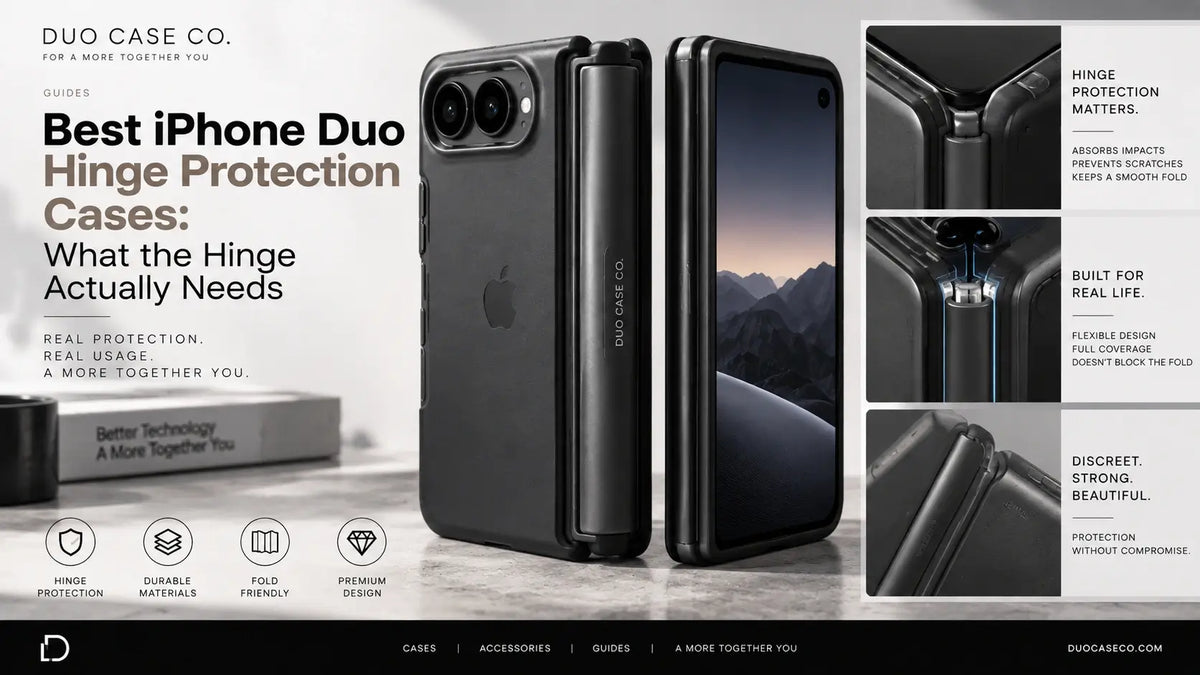
Most articles about foldable hinge protection open with a warning about dust destroying your phone. On the iPhone Duo, that warning is largely out of date — and starting with a scare that the hardware has already solved is a good way to sell you the wrong case.
Apple confirmed an IP68 rating with water resistance to 6 metres. The 6 in IP68 is the dust digit, and it is the highest one: dust-tight. Earlier generations of folding phones from other makers shipped for years with water ratings but no dust rating at all, which is where the reputation came from. The Duo does not have that gap.
So the honest question is not "how do I keep dust out." It is: if the seal is solved, what is left for a case to protect? The answer is mechanical, it is specific, and it changes which case you should buy.
Quick picks
| Best for | Case | Price | Coverage |
|---|---|---|---|
| Overall | Magnetic Hinge Protection Case | $49.95 | Dedicated spine section, magnetic |
| Maximum coverage | Full Protection Kickstand Case | $49.95 | Full spine, stylus included |
| Travel | Hinge Wallet Stand Case | $49.95 | Spine section, cards and stand |
| Note-taking | Hinge Stand Pen Case | $49.95 | Spine section, stand and pen slot |
The fold geometry, in numbers
Start with Apple's confirmed figures, because they tell you something about the hinge design that no press release states directly.
Confirmed folded thickness = 11.3 mm
Difference = 0.9 mm
That 0.9 mm gap is the whole story. It covers the hinge mechanism itself and the fold radius of the display. What it tells you is that the iPhone Duo closes essentially flat — there is no meaningful wedge between the two panels when shut. Earlier book-style foldables from other makers often closed with a visible gap at the outer edge, and that gap is exactly where grit entered and where the panels could be levered apart in a drop.
Combine a near-gapless close with a dust-tight IP68 rating and one conclusion follows: ingress is not your main risk on this device. Impact and leverage are.
What actually damages a folding phone
This is the part we can speak to from operating experience rather than theory. Our team has spent years building and shipping cases for book-style foldables, which means years of reading return reasons and support tickets. Here is how the failure modes rank in practice, and — the part most guides skip — whether a case can do anything about each one.
| Failure mode | What happens | Can a case prevent it? |
|---|---|---|
| Spine impact | The device lands on the closed hinge edge. The spine is narrow, so the whole impact energy concentrates along a thin line directly over the mechanism. | Yes — this is the single strongest argument for hinge coverage. |
| Open-state drop | The device falls while unfolded. The two panels act as levers on the hinge, multiplying force at the pivot far beyond a closed-state drop. | Partly — coverage absorbs some energy but cannot remove the leverage. |
| Objects trapped between panels | A key, a coin, a grain of grit, or a card in a badly designed wallet case. The panels close onto it and press it into the inner display. | Indirectly — a raised fold-edge lip helps; case design that keeps cards on the outer panel matters more. |
| Fold-edge abrasion | Repeated contact along the outer fold edge from pockets and bags wears the finish, then the edge itself. | Yes — any spine coverage handles this. |
| Inner display pressure | Sustained pressure on the flexible panel — sitting on it, over-packing a bag, rigid screen protectors. | No — a case cannot help here. Behaviour is the only fix. |
| Hinge cycle fatigue | Normal mechanical wear over tens of thousands of folds. | No — this is the device's engineering, not the case's job. |
Two of those six are genuinely preventable by a case, and one is partly preventable. That is a smaller claim than most accessory marketing makes, and it is the accurate one.
The four levels of hinge coverage
"Hinge protection" is used loosely across the market and covers four genuinely different constructions. Knowing which one you are buying is more useful than any marketing claim on the listing.
Level 0 — No spine coverage
Two independent shells, nothing across the fold. This is what almost every ultra-thin case on the market is, including the premium minimalist brands. The spine is bare. Perfectly reasonable if you prioritise thinness and are careful; understand that it does nothing for the two preventable failure modes above.
Level 1 — Raised fold-edge lip
No spine bridge, but the shells are moulded with a raised edge along the fold. It keeps the fold edge off flat surfaces and stops small objects sitting directly against the panel edges. Modest protection, almost no thickness penalty.
Level 2 — Dedicated spine section
A separate protective element covering the closed hinge that flexes or articulates with the fold. This is real spine impact protection, and it is the level our main hinge cases sit at. It adds material along the spine, so the folded device gets thicker at the edge you hold most.
Level 3 — Full spine wrap
Maximum coverage across the hinge assembly. The most protection available and the most bulk. Worth it for genuinely hard use, excessive for a device that mostly moves between a desk and a pocket.
The bulk trade, honestly
Every millimetre of spine protection is a millimetre you carry. On this device the proportion is unusually harsh, because the baseline is so thin.
| Configuration | Approx. folded thickness | Increase over bare |
|---|---|---|
| iPhone Duo, bare | 11.3 mm ✅ | — |
| Level 0 thin shell | ~13–13.5 mm ⬜ | ~15–19% |
| Level 2 spine section | ~14–15 mm ⬜ | ~24–33% |
| Level 3 full wrap | ~15–16 mm ⬜ | ~33–42% |
✅ Confirmed from Apple's published specifications. ⬜ Unverified estimate — we will replace these with caliper-measured figures within one week of the 23 October launch.
The same shell that adds under 20% to a conventional iPhone adds over 30% to a folded Duo. That is the real cost of hinge protection and you should weigh it deliberately. A case so bulky that you stop folding the device has cost you the reason you bought a foldable.
The best iPhone Duo hinge protection cases

Magnetic Hinge Protection Case for iPhone Duo
$49.95
- Coverage — Level 2, dedicated spine section
- Best for — the buyer who wants one case and wants it to be the right one
- Magnetic — integrated array for mounts and chargers
- Colours — Gold, Silver, Orange, Blue and more
The best balance of the two things that matter: it covers the spine, and it does not add hardware you did not ask for. No kickstand, no card pocket, no pen slot — just spine coverage plus a magnet array, which keeps the folded profile tighter than the three cases below it.
The metallic finish options are the practical pick on this device. Gold and Silver sit closer to the Duo's titanium frame than the flat black most protective cases default to, which matters when the whole appeal of the hardware is that it looks expensive.
Buy this if you want hinge protection and nothing else. If you want the case to also carry cards, hold a stylus or stand up, take one of the three below and accept the extra millimetres.
Shop this case
Full Protection Kickstand Case With Stylus for iPhone Duo
$49.95
- Coverage — Level 3, full spine wrap
- Best for — trades, site work, parents, frequent droppers
- Extras — kickstand and stylus included
- Colours — Wine Red, Black, Dark Blue, Green and more
The most coverage we sell. This is the case for the two failure modes a case can genuinely prevent — spine impact and fold-edge abrasion — taken as far as the format allows.
The value argument is straightforward on a device starting at $1,999: the case costs roughly 2.5% of the entry-level device price, and hinge or inner-display service on a foldable is among the most expensive repairs the hardware can require.
Stated plainly: this is the bulkiest case in our range and you will notice it in a pocket. Buy it because your environment justifies it. If you are buying it out of general anxiety about a new device, the Level 2 case above is the better purchase and you will carry it more happily.
Shop this case
Hinge Wallet Stand Case for iPhone Duo
$49.95
- Coverage — Level 2, dedicated spine section
- Best for — travel, and one case doing three jobs
- Extras — card storage and kickstand
- Colours — Blue, Black, Beige, Gold and more
The only wallet case in our range that also covers the spine, which is rarer across the whole market than it should be. Most wallet cases treat a foldable as a flat phone with a pocket added; this one acknowledges that the spine is the expensive part.
Note how the two risks interact here. Cards sit on the outer panel, which is the correct placement — a card on an inner face stops the halves closing flat, and given the Duo's 0.9 mm fold clearance, even one card in the wrong place forces a permanent wedge. Two cards on the outer panel is comfortable. Four starts to defeat the point.
More on card placement and flat-close behaviour in our guide to the best iPhone Duo wallet cases.
Shop this case
Hinge Stand Pen Case for iPhone Duo
$49.95
- Coverage — Level 2, dedicated spine section
- Best for — using the 7.6″ display as a notebook
- Extras — kickstand and stylus storage
- Colours — Gray, Brown, Gold, Beige and more
Spine coverage plus a pen slot. The difference between a stylus you own and a stylus you have with you is a slot on the case, and a 7.6″ display is genuinely large enough to write on rather than just tap.
There is a quiet protection benefit here too: writing with a stylus on a propped display means less pressure applied by a thumb against the flexible panel, and sustained pressure on the inner display is one of the failure modes no case can prevent.
Shop this casePartial coverage, if you want less bulk
If the thickness penalty of a Level 2 case is more than you want to carry, these two sit at Level 1 — reinforced frames and raised fold edges rather than a spine bridge.

Clear Kickstand Case With Pen Slot for iPhone Duo
$49.95
- Coverage — Level 1, reinforced frame
- Best for — keeping the titanium visible
- Colours — Black, Silver, Blue, Gold frames and more
A defined bumper along the edges where drops actually land, with the back left transparent. Honest caveat on every clear case including ours: clear TPU yellows under UV over time. If pristine appearance at month 18 matters more than visibility, buy leather or silicone.
Shop this case
Carbon Fiber Magnetic Ring Stand Case for iPhone Duo
$49.95
- Coverage — Level 1
- Best for — preventing the drop rather than surviving it
- Magnetic — yes, with ring stand
- Colours — Gray, Black, Blue, Dark Blue and more
Worth considering as a protection strategy in its own right. A textured finish and a ring you can hook a finger through addresses the drop before it happens, on a 254 g device with a slippery titanium frame. Prevention and absorption are both valid approaches; this case is the first kind.
Shop this caseWho needs hinge protection, and who doesn't
Buy Level 2 or 3 if you: work on a site or in a workshop, carry the phone loose in a bag with keys, hand it to children, cycle or ride with it in a jacket pocket, travel constantly, or have broken a phone in the last two years.
Level 0 or 1 is enough if you: move the device between a desk, a pocket and a car, use a mount rather than holding it while walking, and have not broken a phone in years. In that case buy a thin case and spend the difference on screen protection.
We would rather sell you the $39.95 case you will actually keep on the device than the $49.95 case you remove after three weeks because it made the Duo too thick to enjoy.
How the market handles the hinge
| Option | Hinge coverage | Typical price | Assessment |
|---|---|---|---|
| Apple | Not a stated feature | $79 | Guaranteed fit and a single design. Spine protection is not what this case is sold on. |
| Thin-case specialists | Level 0 by design | $60–$90 | Excellent at what they do. Minimal thickness and spine coverage are mutually exclusive, and they have chosen thinness. |
| Skin and customisation brands | Level 0 | $40–$80 | Finish and appearance rather than impact protection. |
| Marketplace sellers | Claimed, rarely specified | $15–$40 | Often adapted from tall book-foldable moulds. Check whether the spine element articulates or is a stretched panel. |
| Duo Case Co | 4 cases at Level 2–3 | $49.95 | The deepest hinge-protected range for this device, with the coverage level stated for every case. |
The gap is structural rather than accidental. The premium end of this market has built its identity on thinness, and a spine bridge is the opposite of that promise. They are not going to add one. That is the space we build into — and if minimal thickness is genuinely what you want, buy from them instead.
Decision matrix
| If you… | Buy | Level | Price |
|---|---|---|---|
| Want one case, done properly | Magnetic Hinge Protection Case | 2 | $49.95 |
| Work in a rough environment | Full Protection Kickstand Case | 3 | $49.95 |
| Travel constantly | Hinge Wallet Stand Case | 2 | $49.95 |
| Write on the inner display | Hinge Stand Pen Case | 2 | $49.95 |
| Want protection but hate bulk | Carbon Fiber Ring Stand Case | 1 | $49.95 |
| Want to see the titanium | Clear Kickstand Case | 1 | $49.95 |
| Decided you don't need spine coverage | Magnetic Silicone Case | 0 | $39.95 |
Why buy from Duo Case Co
We work on one device. Every product here is built for the iPhone Duo. No tablet section, no unrelated electronics.
We came from foldables, not from phone cases generally. The failure-mode table above is not theory. It is what years of return reasons and support tickets across book-style foldables actually look like, ordered by how often they come up.
We state the coverage level for every case. "Hinge protection" is a marketing phrase across most of this market. We tell you which of the four levels you are buying, including when the answer is Level 0.
We told you a case cannot fix three of the six failure modes. That costs us sales. It is still the right thing to put on the page.
We will publish measurements, including inconvenient ones. Within a week of the 23 October launch this page will carry caliper-measured folded thickness at the spine for every case listed. Where a case measures worse than its specification, that is what this page will say.
Free worldwide shipping to the US, EU, UK, Australia and the Middle East.
What we are not: we have no affiliation with, sponsorship from or endorsement by Apple. We have no customer reviews yet because we have not shipped to customers yet, and we will not manufacture any.
Frequently asked questions
Does the iPhone Duo hinge need protection?
Less than earlier foldables did, and for different reasons than most guides suggest. Apple's confirmed IP68 rating means the device is dust-tight, so the ingress problem that gave foldables their reputation is largely addressed in hardware. What remains is mechanical: impact on the narrow spine, and leverage on the hinge during an open-state drop. Those are what a hinge-protected case addresses.
Will dust destroy my iPhone Duo?
The 6 in IP68 is the dust digit and it is the highest rating available, meaning dust-tight. Apple has confirmed IP68 with water resistance to 6 metres. Earlier book-style foldables from other makers shipped with water ratings but no dust rating at all, which is where the reputation originated. It does not transfer automatically to this device.
How much thickness does a hinge protection case add?
A Level 2 spine section takes a folded iPhone Duo from 11.3 mm to roughly 14–15 mm; a Level 3 full wrap to roughly 15–16 mm. Because the bare device is so thin, that is a 24–42% increase — proportionally far more than the same case would add to a conventional phone. We will publish measured figures after the 23 October launch.
Is hinge protection worth the extra bulk?
It depends entirely on how the device is used. If it travels in a bag with keys, goes to a work site, or is handed to children, yes. If it moves between a desk, a pocket and a car mount, a thin case is the more sensible purchase and you will keep it on the device longer.
What is the most common way foldable phones actually get damaged?
In our experience across book-style foldables, impact on the closed spine is the most common preventable failure, followed by fold-edge abrasion. Open-state drops are less frequent but more severe, because the two panels act as levers on the hinge. Pressure damage to the inner display and normal hinge cycle fatigue are not preventable by any case.
Can I put tempered glass on the inner screen?
No. The 7.6″ inner display is a flexible panel and rigid tempered glass will not survive repeated folding. Use a flexible film. The outer 5.4″ display uses Ceramic Shield 2 and takes tempered glass normally.
What should I avoid in a hinge protection case?
A case where a single continuous piece of soft material is stretched across the spine to act as the hinge. That material becomes the fold point and will crease, then crack. Spine protection should be a designed component that articulates or flexes, not a stretched panel.
Can I order before the iPhone Duo ships?
Yes. All cases are available now, ahead of the 23 October 2026 release. No case from any brand has been verified on retail hardware yet, so check fit as soon as both the case and device are in hand.
Which hinge protection case should I buy if I only buy one?
The Magnetic Hinge Protection Case at $49.95. Level 2 spine coverage, magnetic compatibility, and no extra hardware inflating the folded profile. Step up to the Full Protection Kickstand Case only if your environment genuinely justifies Level 3.
Disclosure: This guide is published by Duo Case Co, which sells the cases listed. We have stated where our range wins, where another option is the better purchase, and which failure modes no case can prevent. iPhone Duo specifications are from Apple's 9 September 2026 announcement and are labelled ✅ Confirmed; case thickness estimates are labelled ⬜ Unverified and will be replaced with measured figures after launch. Failure-mode rankings reflect our own operating experience with book-style foldable cases and are presented as such, not as laboratory test data. No case in this guide has been tested on retail iPhone Duo hardware, because the device ships 23 October 2026 — this applies to every brand selling Duo cases today. Duo Case Co is an independent accessories company and is not affiliated with, sponsored by or endorsed by Apple Inc. Apple, iPhone, iPhone Duo, MagSafe and Ceramic Shield are trademarks of Apple Inc.

Leave a comment
This site is protected by hCaptcha and the hCaptcha Privacy Policy and Terms of Service apply.