
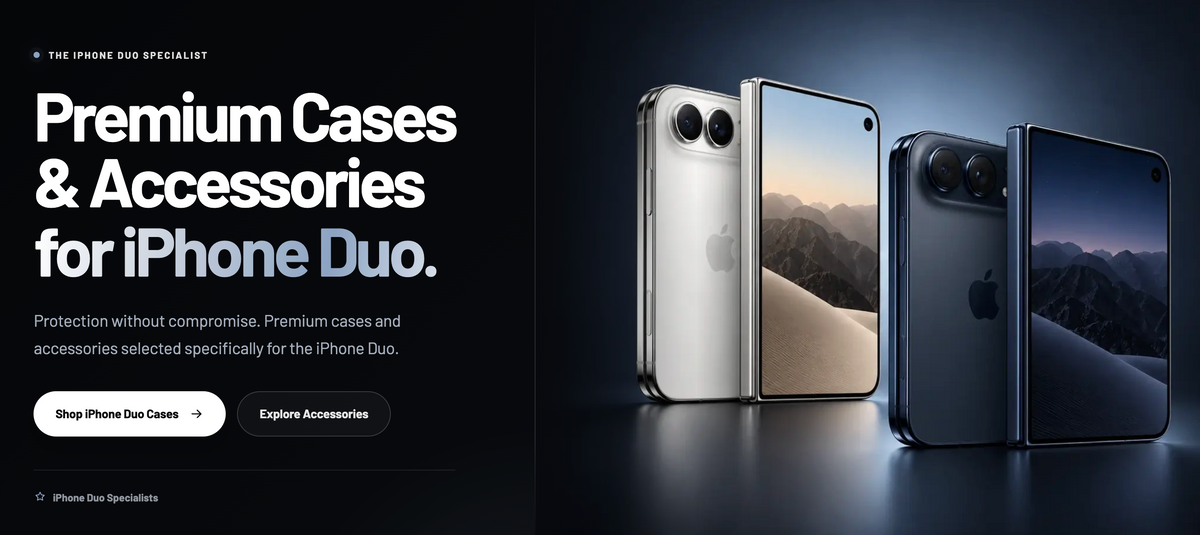
The iPhone Duo has two screens, and they need opposite answers. The 5.4″ outer display is rigid glass that faces your pocket, your keys and the ground, and it should be protected exactly as you would protect any iPhone. The 7.6″ inner display is a flexible folding panel with a surface Apple engineered specifically for it — and covering it with a film undoes part of that engineering.
Apple itself sells no screen protector for the iPhone Duo and has published no guidance on applying one. That leaves buyers guessing, and a lot of listings are happy to sell you a "full coverage" kit for both screens. This guide explains what each display is actually made of, why the inner one should be left alone, and what to buy for the outer one.
Outer 5.4″ display: yes. It is rigid glass, takes the most abuse, and accepts a conventional protector.
Inner 7.6″ display: no. It carries a custom nano-texture finish and anti-reflective coating that a film would cover. Leave any factory layer in place and do not add a second one.
- The two displays, compared
- Why the inner display should not get a film
- Why the outer display needs one most
- Interactive: which protector do you need?
- Protector types for the outer display
- The best iPhone Duo screen protectors
- Case and protector compatibility
- How to install an outer protector
- What else is on the market
- Frequently asked questions
The two displays, compared
| Outer display | Inner display | |
|---|---|---|
| Size | 5.4″ | 7.6″ folding OLED, Super Retina XDR |
| Resolution | — | 1878 × 2670 at 430 ppi |
| Surface | Ceramic Shield 2, rigid | Custom polymer cover, flexible |
| Finish | Standard glass | Custom nano-texture, anti-reflective, oleophobic |
| Apple Pencil | — | Supported |
| Exposure when closed | Fully exposed | Faces inward, protected by the device itself |
| Takes a tempered glass protector? | Yes | No — glass cannot fold |
| Should you add a film? | Yes | No |
Inner display specifications are from Apple's published iPhone Duo technical specifications. Apple has not published hardness, scratch-rating or cleaning guidance for either display.
Why the inner display should not get a film
This is the part most screen-protector listings skip, and it is the most important thing on this page.
1. Apple built the protection into the surface
Apple's specifications list a custom nano-texture finish on the inner display, along with an anti-reflective coating and a fingerprint-resistant oleophobic coating. The nano-texture reduces glare and helps make the centre crease less noticeable. Those are functional properties of the surface itself.
A film sits on top of all of it. Whatever the film's own properties are, it replaces Apple's engineered surface with a different one: you lose the anti-glare nano-texture you paid for, the crease becomes more visible rather than less, and the feel under your finger and under Apple Pencil changes.
2. Glass cannot fold, and film is a compromise
Tempered glass protects because it is rigid — rigidity is what spreads the force of a knock across its surface. That same rigidity means it cannot bend. Any product sold as tempered glass for a folding inner display is either not tempered glass or will not survive folding.
Flexible films can physically stick to a folding panel. But "it adheres" and "it has been validated across thousands of fold cycles on this specific display" are different claims. Films on foldables are known to lift and bubble at the crease, which is exactly where you do not want adhesive working loose.
3. There may be a factory layer — leave it alone
Folding phones from other makers ship with a protective layer already applied to the inner display, and it is part of the display stack rather than packaging. Owners of earlier foldables learned this the hard way by peeling it off. Apple has not confirmed whether the iPhone Duo ships with such a layer.
4. The inner display is already protected most of the time
When the iPhone Duo is folded, the inner display faces itself. It is not in contact with keys, coins or the table. Apple confirms a dust-tight IP68 rating, so grit ingress is also far less of a concern than on earlier foldables. The inner screen's real risks are things closed onto it — a key, a card, a grain of grit — and a film does not prevent those. Not closing the phone on anything does.
Why the outer display needs protection most
Consider how the device is actually used. Folded, the iPhone Duo behaves like a thick conventional phone, and the 5.4″ outer display takes every notification check, every quick reply, every camera preview while standing up. It faces outward in your pocket and makes first contact in a face-down drop.
That is the same exposure as a normal iPhone screen, concentrated on a single panel you cannot fold away. It is rigid Ceramic Shield 2 glass, so it accepts a conventional protector exactly as any iPhone does. This is the screen to protect, and it is the only one we make protectors for.
iPhone Duo: $1,999 starting price ✅
Apple repair pricing for either Duo display: not yet published
Our outer protector: $19.95 for three — $6.65 per protector
Which protector do you need?
Three questions, one answer
Pick one answer per question.
1. Do you use your phone in public where others can see the screen — commuting, cafés, open offices?
2. How rough are you on phones?
3. Do you already have a case?
Protector types for the outer display
| Type | What it does | Trade-off | Best for |
|---|---|---|---|
| Clear tempered glass | Takes scratches and shallow impacts so the display doesn't | Adds a little thickness; edges can lift under a case lip | Almost everyone |
| Privacy glass | Narrows the viewing angle so the screen is unreadable from the side | Screen looks dimmer; harder to share the screen with someone beside you | Commuters, open offices, travel |
| Plastic film | Stops light scratches | Little impact protection; can feel soft | Minimalists |
| Nothing | Keeps Ceramic Shield 2 bare | Scratches land on the display itself | Careful owners who replace phones often |
The best iPhone Duo screen protectors

3-Pack Outer Screen Protector for iPhone Duo
$19.95 — $6.65 each
- Covers — the 5.4″ outer display only, by design
- Pack — three protectors
- Best for — everyone who uses the outer screen, which is everyone
The outer display is the screen that takes the damage, and this covers it and nothing else. We deliberately do not make an inner-display protector, for the reasons set out above — and we would rather tell you that than sell you a kit that covers a surface Apple engineered to be left bare.
Three in the pack matters more than it sounds. A protector is a consumable: its job is to take the scratch so the display does not, and a scratched protector has done its job. A spare means you replace it the day it happens rather than living with a scuffed outer screen for a week. The third covers a botched first install.
Shop the 3-pack
Privacy Screen Protector for iPhone Duo
$19.95
- Covers — the 5.4″ outer display
- Does — narrows the viewing angle so the screen is unreadable from the side
- Best for — commuters, open offices, anyone reading messages in public
The outer display is the one you read in public — notifications on a train, messages in a queue — so it is the right screen for a privacy filter. From straight on you see the display normally; from the side, the person next to you sees very little.
Honest trade-offs, which apply to every privacy protector from every brand: the screen looks dimmer than bare glass, so you may nudge brightness up, and showing your screen to someone beside you becomes harder. If you rarely use your phone where others can see it, take the clear 3-pack instead.
Shop privacy protectorCase and protector compatibility
This is where outer protectors usually fail, and it has nothing to do with the protector itself.
A case with a raised lip around the outer display can press on the edge of a screen protector. Over days of pocket pressure, that lip works the protector's edge loose, and once the edge lifts, dust gets under it and it bubbles. The protector looks faulty; the real cause is the pairing.
Pairings that make sense
Everyday
Outer 3-pack + Magnetic Hinge Protection Case
$69.90
Outer screen and spine covered — the two exposed surfaces.
Minimal
Outer 3-pack + Magnetic Silicone Case
$59.90
Lowest bulk, still magnetic. Less than Apple's $79 case alone.
How to install an outer screen protector
- Remove the case. Install on the bare phone, then refit the case. Installing with the case on is the most common cause of misalignment.
- Work somewhere dust-free. A bathroom after a hot shower is the classic trick — the steam settles airborne dust.
- Clean the outer display only. Use the wipe in the box, then the dry cloth, then the dust sticker. Do not use the wipe on the inner display.
- Align before you touch the glass. Line up the cutouts at the top edge first, then lower the protector onto the display.
- Press from the centre outward. Push small bubbles toward the nearest edge with the card or cloth.
- Leave it for an hour before refitting the case. Give the adhesive time to settle at the edges, where a case lip would otherwise lift it.
What else is on the market
| Source | Outer display | Inner display | Notes |
|---|---|---|---|
| Apple | None | None | Sells no screen protector and publishes no guidance on applying one |
| Cygnett | Yes (FoldShield) | Deliberately none | 2-year warranty stated; explicitly declines to make an inner protector |
| TORRAS | Yes, tempered glass | Deliberately none | States tempered glass is for the 5.4″ cover display only |
| "Full coverage" kits | Yes | Film included | Cover the inner nano-texture surface; not recommended |
| Duo Case Co | 3-pack clear + privacy | Deliberately none | $19.95, free worldwide shipping, pairs with 12 Duo cases |
The pattern is worth noticing. The accessory makers that have thought hardest about this device — Cygnett, TORRAS and us — have independently reached the same conclusion: protect the outer display, leave the inner one alone. The products covering both screens are the ones to be sceptical of.
Where we differ from Cygnett and TORRAS: a three-pack at $19.95 rather than a single protector, a privacy option, and the ability to buy the case and protector in one order with free worldwide shipping. Where they are ahead: Cygnett publishes a two-year warranty, and both are established screen-protection brands.
Why buy from Duo Case Co
We don't sell an inner-screen protector. It would be easy money and it would be the wrong product. That is the whole reason to trust the rest of this page.
We work on one device. Protectors, cases and accessories for the iPhone Duo, nothing else.
One order, both surfaces. Pair an outer protector with a hinge-protected case and you have covered the two parts of the device that actually get damaged.
We will publish compatibility. Every case in our range tested against our outer protectors when the device ships on 23 October.
Free worldwide shipping to the US, EU, UK, Australia and the Middle East.
We have no affiliation with, sponsorship from or endorsement by Apple. We have no customer reviews yet because we have not shipped to customers yet, and we will not manufacture any.
Frequently asked questions
Does the iPhone Duo need a screen protector?
The outer display does. It is rigid Ceramic Shield 2 glass that faces your pocket and makes first contact in drops, exactly like a conventional iPhone screen. The inner folding display should not have a protector added — it carries a custom nano-texture finish that a film would cover.
Can you put a screen protector on the iPhone Duo inner screen?
A thin flexible film may physically stick, but Apple has not approved or recommended any third-party inner-screen protector. The inner display has a custom nano-texture finish, anti-reflective coating and oleophobic coating; a film covers all three, and films on folding displays are prone to lifting at the crease.
Can I use tempered glass on the iPhone Duo?
On the outer 5.4″ display, yes. On the inner 7.6″ folding display, no — tempered glass protects by being rigid, and rigid glass cannot fold. Any product sold as tempered glass for the inner display is either not tempered glass or will not survive folding.
Does Apple sell an iPhone Duo screen protector?
No. Apple sells two iPhone Duo cases — the $79 iPhone Duo Case and the $129 Folio with Kickstand — but no screen protector, and has published no guidance on applying one to either display.
Does the iPhone Duo come with a screen protector on the inner display?
Apple has not confirmed it. Folding phones from other makers ship with a factory layer on the inner display that is part of the display stack. If your iPhone Duo arrives with one, do not peel it off unless Apple's instructions say to.
What happens if I peel off the factory inner layer?
On other foldables, removing it has damaged the display, because it is part of the display stack rather than packaging. If the layer on your iPhone Duo bubbles or lifts, take it to Apple or an Apple Authorized Service Provider rather than removing it yourself.
Is a privacy screen protector worth it?
If you read messages in public, yes — the outer display is the screen you use in queues and on trains. Expect the screen to look dimmer and sharing your screen with someone beside you to become harder. If you rarely use your phone around others, a clear protector is the better choice.
Why does my screen protector keep lifting at the edge?
Usually because the case lip sits on the protector's edge and works it loose. Install the protector first, then check the case lip sits beside the protector rather than on top of it.
Will a screen protector work with a case?
Yes, provided the case lip clears the protector's edge. We will publish tested pairings for every case in our range after the 23 October launch.
How do I protect the inner display if not with a film?
Never close the phone with anything between the screens — a key, a card, a grain of grit. Clean it with a dry microfibre cloth. Use a case with raised edges so the open phone's screen does not rest on a table. Those prevent the damage that actually happens to inner displays.
Disclosure: This guide is published by Duo Case Co, which sells the outer-display protectors described. Inner display specifications — the 7.6-inch folding OLED, resolution, custom nano-texture finish, anti-reflective and oleophobic coatings, and Apple Pencil support — are from Apple's published iPhone Duo technical specifications. Apple has not published hardness ratings, scratch ratings, cleaning guidance or repair pricing for either display, and has not confirmed whether a factory layer is applied to the inner display. Competitor information on Cygnett and TORRAS is taken from their own published product pages. Duo Case Co is an independent accessories company and is not affiliated with, sponsored by or endorsed by Apple Inc. Apple, iPhone, iPhone Duo, Apple Pencil and Ceramic Shield are trademarks of Apple Inc.



Leave a comment
This site is protected by hCaptcha and the hCaptcha Privacy Policy and Terms of Service apply.